
Last reviewed May 10, 2026
Quick answer: Perimenopause joint pain hits multiple joints simultaneously because estrogen affects connective tissue everywhere, not just one joint. Estrogen receptors live in cartilage, synovium, fascia, and tendons. As estrogen drops, the entire connective-tissue system shifts toward fibrosis, reduced lubrication, and inflammation — producing polyarticular pain across hips, fingers, knees, back, and shoulders simultaneously. About 50-70% of midlife women report joint pain (Magliano 2010, Climacteric). HRT addresses the systemic cause; observational data show 20-40% less joint pain in HRT users vs controls (Chlebowski 2013).
The 60-second version
Three different joints, three different doctors, one cause
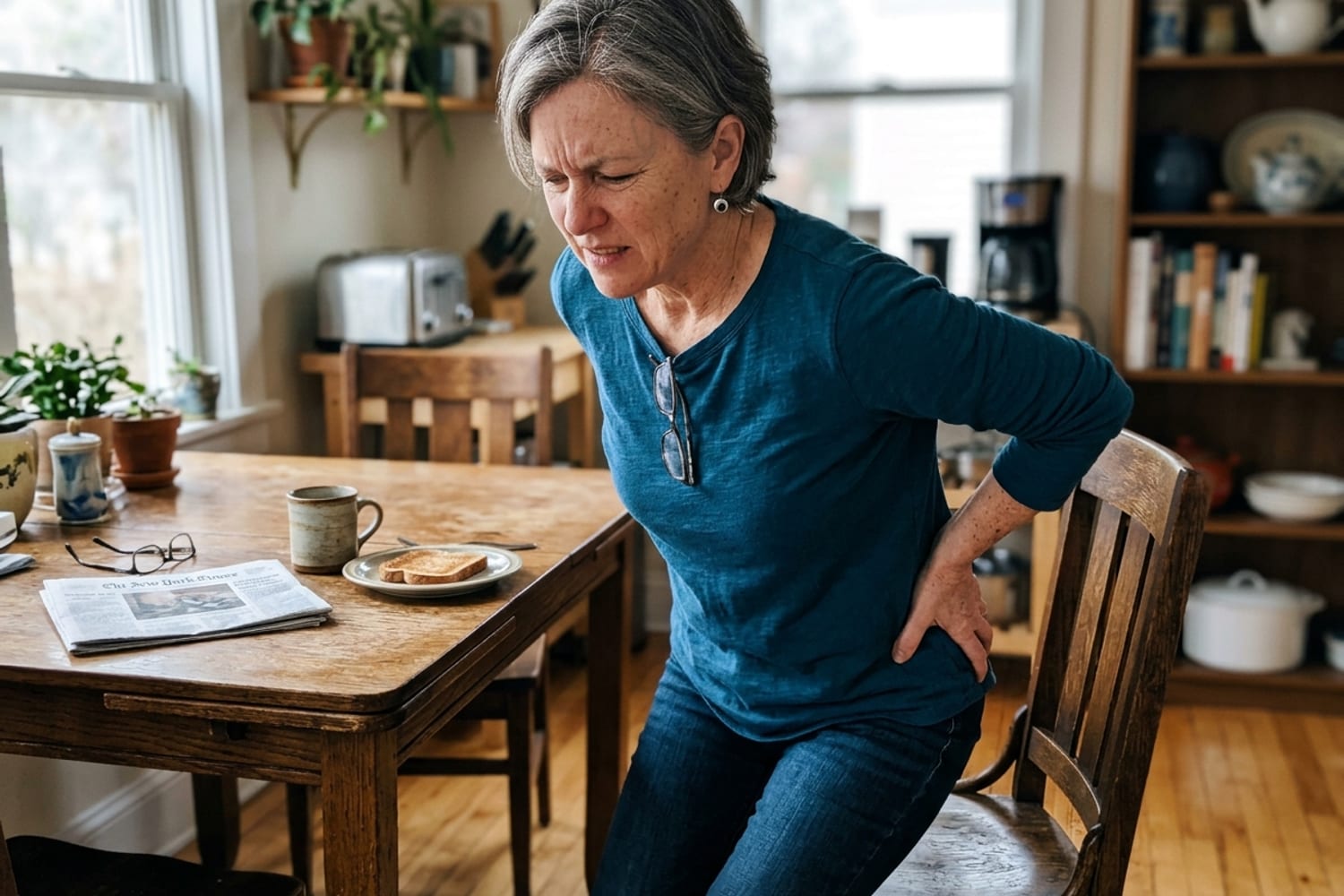
Your right hip aches when you stand up from the couch. Your fingers are stiff for the first 45 minutes after you wake up — you can't grip the toothpaste tube. Your knees grumble on stairs in a way they did not last year. Your lower back is tight in a new way. And the worst part is: every doctor you've seen has treated it as a separate problem. The orthopedist sent you for a hip MRI. The hand specialist gave you a wrist splint. Your primary care doctor said your knees are "just getting older." Nobody is connecting them.
They are connected. The pattern of perimenopause joint pain is polyarticular — multiple joints flaring at once, often symmetric, often worse in the morning, often clustering with hot flashes and sleep changes and the rest of the perimenopause picture. The reason is simple and almost never explained in a clinic visit: estrogen receptors are everywhere in your connective tissue. Cartilage. Synovial lining. Tendon. Ligament. Fascia. As estrogen drops in perimenopause, all of those tissues shift at once — drier, stiffer, more inflammatory, slower to repair. The pain shows up wherever the load is highest, which is why one woman's loudest joint is her hip and another's is her fingers and another's is her knees.
This article is the polyarticular framing nobody walked you through. It is the perimenopause joint pain explainer with the actual estrogen-connective-tissue mechanism, the prevalence numbers most blogs miss, where the pain shows up, what helps (ranked by evidence), what to stop spending money on, when the pain isn't menopause, and what HRT actually does for it. If you searched perimenopause hip pain or menopause and joint pain at midnight on your phone, this is the article that should have come up first.
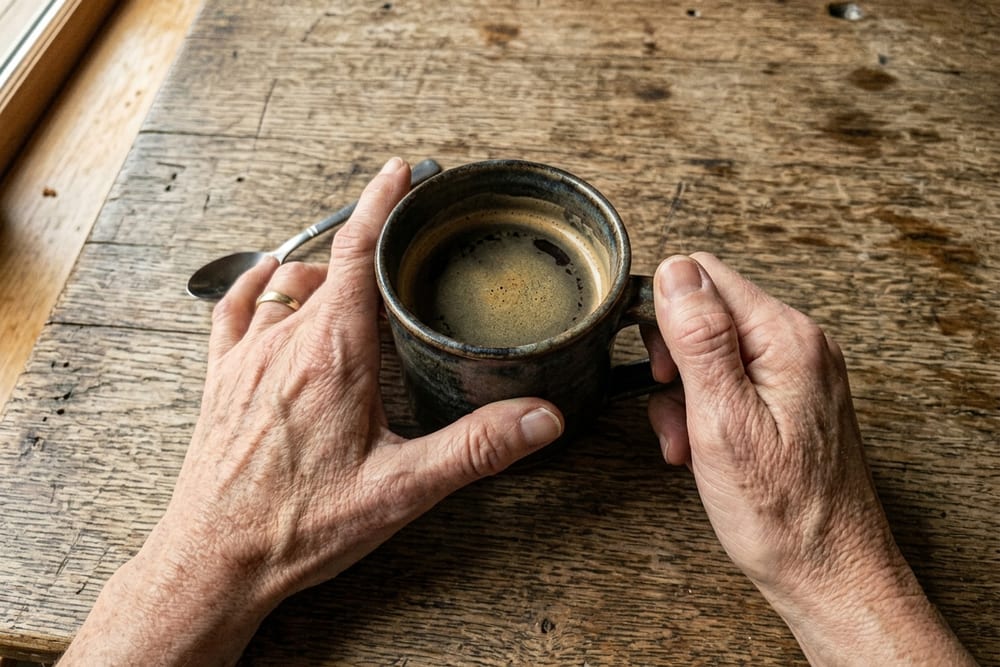
The hip, the fingers, the knees, the back — they are not separate problems. Estrogen receptors live in cartilage, synovium, fascia, and tendon system-wide. The pain pattern is a hormonal cluster, not a coincidence.
Magliano's 2010 review in Climacteric documented that 50-70% of perimenopausal and postmenopausal women report joint pain — far higher than age-matched men, and the gap appears around the menopausal transition itself rather than gradually over the lifespan. Roman-Blas et al. (2009) demonstrated estrogen receptor (ER-alpha and ER-beta) expression in chondrocytes, the cells that maintain cartilage. Watt (2018) in Current Opinion in Rheumatology reviewed the cartilage-homeostasis effects of estrogen withdrawal — accelerated proteoglycan loss, increased catabolic cytokine signaling, reduced type II collagen synthesis. Saltzman et al. (2023) at Duke specifically tied frozen shoulder incidence to HRT status. Felson's classic 1998 work documented the postmenopausal acceleration of hand and knee osteoarthritis. Five different research lines, one mechanism: estrogen is a systemic connective-tissue regulator, and its withdrawal produces a polyarticular pain syndrome.
Citations: Magliano M. Menopausal arthralgia: Fact or fiction. Maturitas. 2010;67(1):29-33. PMID: 20670199 · Watt FE. Hand osteoarthritis, menopause and menopausal hormone therapy. Maturitas. 2018;111:42-47. PMID: 29227361 · Roman-Blas JA, et al. Osteoarthritis associated with estrogen deficiency. Arthritis Res Ther. 2009;11(5):241. PMID: 19261113 · Felson DT, Nevitt MC. The effects of estrogen on osteoarthritis. Curr Opin Rheumatol. 1998;10(3):269-272. PMID: 9514611 · Chlebowski RT, et al. Estrogen alone and joint symptoms in the Women's Health Initiative. Menopause. 2013;20(6):600-608. PMID: 24160567.
Where perimenopause joint pain shows up
Perimenopause joint pain is not one symptom — it is a pattern of overlapping joint flares, and women rarely experience just one. Most women have at least two of the six common locations going at once. The constellation matters more than any individual joint. If your hip is the loudest but your fingers are also stiff and your back is tighter than it used to be, the polyarticular pattern is itself diagnostic information. Here are the six locations, in roughly the order patients describe them:
1. Hip pain
The most-Googled location. Often presents as lateral hip ache (trochanteric region) or anterior groin discomfort, worst on rising from a chair or climbing stairs. The hip joint, gluteal tendons, and IT band are all hormone-sensitive connective tissue. Frequently misdiagnosed as bursitis or hip-flexor strain.
2. Lower back
New stiffness on waking, worse after sitting. The thoracolumbar fascia and lumbar facet joints share the same connective-tissue physiology. Often shows up as a band of tightness rather than a sharp pain — mistaken for "I slept funny" for months before it gets named.
3. Finger / hand stiffness
Morning stiffness in PIP and DIP joints, lasting 30-60 minutes. The earliest and most specific sign in many women. Long-lasting morning stiffness over an hour or visible swelling deserves a rheumatology workup to rule out RA — but the brief sub-hour pattern is hormonal.
4. Knees
The "stairs are louder this year" pattern. Often bilateral, often worse going down than up. Pre-existing patellofemoral or meniscal issues will accelerate at the menopausal transition. Felson (1998) documented the postmenopausal jump in knee osteoarthritis incidence.
5. Shoulders (frozen shoulder)
Adhesive capsulitis — the painful shoulder-stiffening that resists raising your arm — has a striking predilection for women aged 40-60. Saltzman et al. (2023) at Duke linked HRT use to lower incidence. See our frozen shoulder & menopause article for the full clinical picture.
6. Neck and TMJ
Under-discussed but common. Cervical spine stiffness and temporomandibular joint pain (jaw aches, clicking, headaches that radiate from the jaw) both involve connective-tissue compartments rich in estrogen receptors. Often mistaken for stress-driven tension and treated with night guards alone.
The diagnostic move most women miss is to map all six locations on a single sheet of paper. Doing that for two weeks — which joints flared on which days, what the morning stiffness duration was, whether a hot flash preceded a flare — produces more useful pattern data than three specialty visits combined. The polyarticular cluster, when laid out on one page, makes the hormonal explanation almost obvious. If your sheet shows hip + fingers + knees + a shoulder, the unifying explanation is upstream of every individual joint.
The mechanism: why estrogen drops cause whole-body joint pain
Here is the part nobody explains in the clinic, and the part that makes the polyarticular pattern make sense. Estrogen is not a "reproductive hormone" with a side effect on joints. Estrogen is a systemic connective-tissue regulator, and its receptors are expressed across nearly every joint-related tissue in the body. Roman-Blas et al. (2009) in Arthritis Research & Therapy documented estrogen receptor (ER-alpha and ER-beta) expression in cartilage chondrocytes — the cells that synthesize and maintain the proteoglycan-rich extracellular matrix that gives cartilage its lubrication and shock absorption. Estrogen receptors are also present in synovial lining cells, tendon fibroblasts, ligament cells, and fascia.
Estrogen does at least four relevant things to all of those tissues simultaneously. First, it suppresses inflammatory cytokines — IL-1, IL-6, and TNF-alpha. As estrogen drops, those cytokines rise, and joint tissue becomes more inflammatory. Second, estrogen supports type II collagen synthesis in cartilage and tendon; loss of estrogen accelerates collagen turnover without matched synthesis, so connective tissue degrades faster than it rebuilds. Third, estrogen maintains the proteoglycan matrix that holds water in cartilage; cartilage gets drier, less compressible, and more prone to mechanical wear. Fourth, estrogen modulates fascia and tendon stiffness via the same collagen and elastin pathways; fascia loses elasticity, tendons become stiffer and more fibrotic, and the connective-tissue scaffold of every joint moves toward a "frozen" state.
This is why the pain pattern is polyarticular and not isolated to one joint. The classic mistake is to chase the loudest joint with a structural explanation — bursitis, tendinopathy, early OA, frozen shoulder — and miss that the same hormonal cascade is hitting every other connective-tissue compartment in the body at the same time. Watt's 2018 review in Maturitas made this point explicitly for hand osteoarthritis: the postmenopausal hand-OA pattern is not just "more wear and tear with age," it is a hormonally-driven acceleration that maps onto the menopausal transition specifically.
The Saltzman et al. (2023) Duke study extended the same logic to frozen shoulder. They found women on HRT had substantially lower frozen-shoulder incidence than untreated controls — supporting the connective-tissue mechanism, because frozen shoulder is a fascia-and-capsule fibrosis disorder, not a degenerative cartilage disorder. Different joint, different substrate, same hormonal driver, same protective effect of estrogen restoration. The Magliano 2010 review and Roman-Blas 2009 paper both pull the same thread: menopausal arthralgia is a real, mechanistically distinct clinical entity, not a vague "aging" complaint.
The clinical takeaway is also the article's whole point. Most women with perimenopause joint pain see an orthopedist for the hip, a hand specialist for the fingers, a sports-med doctor for the knees, neither connects them, each gets a localized workup and a localized treatment. The localized treatments are usually fine for what they target — but they leave the upstream driver entirely untouched. The upstream driver is hormonal. The lever that addresses the upstream driver is hormonal too. Everything else is downstream symptom management.
What helps perimenopause joint pain (ranked by evidence)
Five interventions make the evidence-ranked short list for perimenopause joint pain, plus a sixth that addresses the muscle-tension layer most women add on top. The first is the only one that targets the systemic cause; the next four are downstream supports that compound over months. Read this list in order — the order is the priority.
1. HRT — the only systemic lever
The cause of perimenopause joint pain is system-wide estrogen withdrawal acting on connective tissue everywhere at once. The fix that addresses the cause is to restore estrogen — system-wide. Systemic HRT (transdermal estradiol patch or gel, oral estradiol with progesterone if you have a uterus, or a compounded estrogen-and-progesterone body cream) is the only intervention that can plausibly act on cartilage, synovium, tendon, fascia, and ligament simultaneously. The Chlebowski 2013 ancillary analysis of the Women's Health Initiative showed women on estrogen reported 20-40% less joint pain than placebo controls. The Saltzman 2023 Duke study showed lower frozen-shoulder incidence in HRT users. Magliano's 2010 review in Climacteric summarized the broader observational evidence: women on HRT consistently report less joint pain than untreated peers.
Clinically, perimenopause joint pain typically improves within 4-8 weeks of HRT initiation, with continued improvement through 6 months. The arc parallels hot flashes and sleep — the same hormonal lever stabilizes all three. Our companion piece on signs you need HRT walks through when this conversation is worth having; our HRT timeline piece covers what to expect week by week.
2. Strength training (counterintuitively, more — not less)
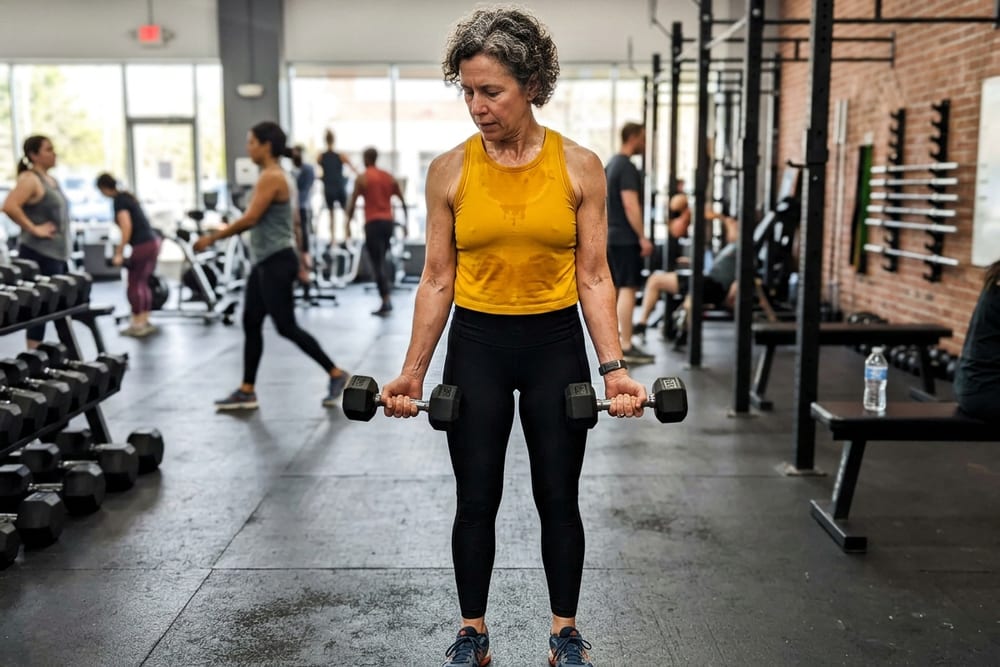
The instinct when joints hurt is to rest the joint. The evidence says the opposite: loaded connective tissue rebuilds itself; unloaded connective tissue stiffens further. Progressive resistance training — twice weekly, full-body, targeting the major movement patterns (squat, hinge, push, pull, carry) with 6-12 reps per set — has the strongest non-pharmacological evidence base for perimenopausal joint pain and bone density combined. The mechanism is mechanotransduction: cyclical mechanical loading signals chondrocytes, tendon fibroblasts, and bone osteocytes to remodel and lay down new matrix. Estrogen amplifies this effect; you do not need estrogen for it to work, but you do not get to skip it either.
The common mistake is to drop strength training because joints hurt. The right move is to drop the high-impact running and add or expand strength training. Start under-loaded (bands, light dumbbells), focus on full range of motion, build slowly. A two-month strength block produces measurable improvements in joint discomfort and function in midlife women across multiple randomized trials.
3. Mediterranean / anti-inflammatory diet pattern
The dietary pattern with the most consistent evidence for joint pain is Mediterranean — heavy on vegetables, olive oil, fatty fish, legumes, and nuts; light on processed foods, refined carbohydrates, and ultra-processed seed oils. The mechanism is anti-inflammatory: omega-3 fatty acids, polyphenols, and high fiber all dampen the IL-6 / TNF-alpha cytokine axis that perimenopause is amplifying. Effect size for joint pain specifically is modest — this is a compounding intervention, not a fast fix — but it stacks with HRT and strength training without any side-effect cost. Two grams per day of combined EPA/DHA from oily fish or fish-oil capsules is the simplest single change with consistent randomized-trial evidence.
4. Magnesium glycinate for muscle tension
Most perimenopause joint pain is layered with muscle-tension pain — tight glutes around an aching hip, tight upper traps around a stiff neck, tight quads around a creaky knee. Magnesium glycinate at 200-400 mg at bedtime reduces muscle tension and improves sleep, both of which compound joint pain when they are missing. The evidence base is modest but the side-effect profile is excellent (occasional loose stools at higher doses; otherwise well tolerated). Magnesium does not treat the joint pathology directly — it addresses the muscle-tension overlay that makes the joint pain feel worse. See our top perimenopause supplements 2026 audit for the broader supplement landscape.
5. Targeted physical therapy for the worst single joint
Even when the pain is polyarticular, one joint is usually the loudest, and targeted physical therapy for the loudest joint reduces the daily load on the rest. PT for hip pain, frozen shoulder, or knee pain is well-established and effective; PT does not need a hormonal explanation to work. The point is sequencing: address the upstream driver (HRT) and the systemic supports (strength, diet, sleep) at the same time as the local PT, not instead of them. PT alone leaves the connective-tissue cascade running across every other joint.
6. Sleep, the silent multiplier
Joint pain is worse with bad sleep, and perimenopause sleep is bad. Pain thresholds drop measurably after even one short night, which is why the same hip aches more on a 5-hour night than a 7.5-hour night. HRT often fixes the sleep problem (which fixes the pain-amplification problem), but if you are early in the conversation, magnesium at bedtime, room temperature 65-68°F, and keeping a strict 7.5-hour sleep window are the sleep interventions with the highest yield. Our progesterone and sleep piece covers the hormonal sleep mechanics.

What DOESN'T help (and what to stop spending money on)
The "joint health" supplement aisle is enormous and the published evidence behind most of it is weak. A short audit of where the menopause-joint-pain market wastes money:
- Most "joint health" supplement stacks (glucosamine, chondroitin, MSM combinations). Mixed-to-weak evidence in osteoarthritis and essentially no evidence specifically for perimenopausal joint pain. Glucosamine sulfate at 1500 mg/day has the least-bad data, and even that is inconsistent across meta-analyses. Not harmful, but not the lever — and not a substitute for the systemic intervention.
- Topical CBD products without published trial data. The category is nearly all marketing. The few randomized trials of topical CBD for osteoarthritis show small, inconsistent effects. Most products on the shelf have no published data of any kind; some have unverified concentrations.
- Infrared saunas as a primary treatment. Pleasant, possibly helpful for muscle relaxation, no strong evidence for the connective-tissue cascade itself. Fine as a recovery adjunct; not a substitute for HRT, strength training, or PT.
- Collagen peptide supplements. The meta-analyses for joint outcomes are mixed and most studies are industry-funded. Effect sizes when reported are small. Dietary protein adequacy (1.0-1.2 g/kg/day) accomplishes most of what collagen peptides claim, more cheaply.
- Daily NSAIDs (ibuprofen, naproxen) as a maintenance strategy. Effective short-term for inflammation but produce GI, renal, and cardiovascular risk with chronic use. Reasonable for flares; not a chronic answer for a 5-10-year perimenopausal window.
- Cortisone injections as the only intervention. Powerful for a single inflamed joint short-term, but the underlying connective-tissue cascade keeps running. Repeated injections in a single joint accelerate cartilage thinning over years. Use sparingly and as part of a broader plan, not as the plan.
The pattern across all of these: they are downstream of the connective-tissue cascade, or they target the wrong layer. The interventions that work — HRT, strength training, anti-inflammatory diet, magnesium, targeted PT — either address the upstream hormonal driver or build the connective-tissue substrate that estrogen used to maintain.
When joint pain ISN'T perimenopause — the rule-outs
Perimenopause joint pain is real, but joint pain that does not fit the polyarticular hormonal pattern needs a workup before assuming hormones. Here are the rule-outs every clinician should walk through:
- Rheumatoid arthritis. Symmetric small-joint involvement (especially MCPs and PIPs of hands), morning stiffness lasting more than an hour, visible joint swelling, fatigue, and elevated rheumatoid factor or anti-CCP antibodies. Onset around midlife is common, which is exactly why the differential matters. Untreated RA causes joint destruction; the workup is non-negotiable.
- Lupus and other connective-tissue autoimmune disease. Joint pain plus rash (especially malar/butterfly), photosensitivity, fatigue, oral ulcers, kidney findings, or low platelet/white-cell counts. ANA screen with reflex panel.
- Lyme disease. In endemic regions, monoarticular or oligoarticular knee swelling weeks to months after a possible tick exposure, sometimes with a rash or flu-like prodrome. Two-tier ELISA + Western blot serology.
- Gout. Sudden severe single-joint pain, classically the first MTP (big toe), often nocturnal, with redness and swelling. Check serum uric acid (though it can be normal during a flare) and consider joint aspiration.
- Polymyalgia rheumatica. Symmetric shoulder and hip-girdle pain and stiffness in older women (typically over 50), with markedly elevated ESR or CRP, dramatic response to low-dose prednisone. Often confused with menopausal arthralgia early in its course.
- Hypothyroidism. Diffuse joint and muscle pain, fatigue, cold intolerance, weight changes — all easily misread as menopause and easily ruled in or out with a TSH.
- Vitamin D deficiency. Diffuse musculoskeletal pain that can mimic arthralgia. Check 25-OH vitamin D and replete to 30-50 ng/mL.
The differentiating signs of menopausal arthralgia versus the rule-outs above: polyarticular but asymmetric flares; morning stiffness under an hour; clusters with hot flashes, sleep changes, irregular periods, mood changes; normal rheumatoid factor and anti-CCP and ANA; normal ESR/CRP; symptoms started somewhere around the menopausal transition and progressed with it. If your picture matches that pattern, the working diagnosis is hormonal — and the lever is hormonal.
Red flags that mean stop and call your doctor: single-joint redness, warmth, and severe pain (possible septic joint or gout); morning stiffness lasting more than an hour with visible swelling; joint pain plus weight loss, fevers, or rashes; new joint pain with a recent tick exposure; sudden inability to bear weight on a joint. None of these are "just perimenopause." All warrant same-week evaluation.
The intervention comparison table
Side by side, here is how the evidence-ranked options stack up for perimenopause joint pain. The "notes" column is the one that determines whether each tool is right for your specific picture.
| Intervention | Mechanism | Evidence | Notes |
|---|---|---|---|
| HRT (systemic estradiol +/- progesterone) | Restores estrogen signaling across all connective tissue | WHI ancillary (Chlebowski 2013); observational case series; Saltzman 2023 (frozen shoulder) | Targets cause; ~4-8 wk to effect; needs MD review |
| Strength training (2x/week) | Mechanotransduction → connective tissue rebuilds | Multiple RCTs in midlife women for pain + function | Counterintuitive: more, not less; start under-loaded |
| Mediterranean diet + omega-3 (2g EPA/DHA) | Anti-inflammatory cytokine modulation | Strong general; modest effect for joint pain specifically | Compounds with HRT; no side-effect cost |
| Magnesium glycinate 200-400 mg HS | Reduces muscle tension; improves sleep | Modest; targets the muscle-tension layer, not joint per se | Loose stools at higher doses; otherwise well tolerated |
| Targeted PT for loudest joint | Loads and rehabs the worst single joint | Strong for hip, knee, frozen shoulder individually | Add to systemic plan; not a replacement |
| Glucosamine/chondroitin/MSM stacks | Proposed cartilage substrate support | Mixed/weak in OA; minimal in perimenopause specifically | Not harmful; not the lever |
| Topical CBD without trial data | Proposed local anti-inflammatory | Few trials, small/inconsistent effects, unverified products | Mostly marketing; skip absent published data |
| Infrared sauna as primary treatment | Heat-based muscle relaxation | Weak for connective-tissue cascade; pleasant adjunct | Fine recovery tool; not a primary lever |
How ClearedRx prescribes HRT for perimenopause joint pain
ClearedRx is a doctor-supervised HRT service for women, online. You take a one-minute quiz. A licensed physician in our network reviews your symptoms and history within 24 hours. If you are a fit, they prescribe — and your treatment ships to your door, discreetly, the same week. We prescribe both compounded and FDA-approved HRT preparations; the patient picks based on cost, format preference, and clinical fit.
For perimenopause joint pain specifically, the preparation that matters is systemic HRT — transdermal estradiol patch or gel, oral or transdermal estradiol with progesterone if you have a uterus, or a compounded estrogen-and-progesterone body cream applied to thigh or arm. Local vaginal estrogen does not consistently help joint pain because it produces minimal systemic absorption and cannot reach cartilage, tendon, or fascia in meaningful concentrations. For perimenopause joint pain, you want a systemic preparation that stabilizes estrogen levels across the day and across all the connective-tissue compartments at once.
Most women who add systemic HRT for perimenopause joint pain see improvement within 4-8 weeks, with continued progression through 6 months. The arc usually mirrors the arc for hot flashes and sleep. Cost framing the way our patients experience it: ClearedRx HRT starts at $49 per month for compounded preparations and $89 per month for FDA-approved generics, all-in (medication, doctor reviews, free shipping in all 50 states). New patients receive 50% off their first month. There are no surprise fees and no insurance paperwork. For broader cost context, our HRT cost comparison walks through every formulation across every channel.

"Estrogen modulates inflammatory cytokine signaling, supports type II collagen synthesis in cartilage, and maintains the proteoglycan matrix essential for cartilage homeostasis. Estrogen withdrawal at the menopausal transition produces a connective-tissue phenotype distinct from age-related osteoarthritis alone, and is plausibly modifiable by hormone therapy." — Watt FE. Hand osteoarthritis, menopause and menopausal hormone therapy. Maturitas. 2018;111:42-47.
If you also want to map the rest of the picture
Perimenopause joint pain almost never travels alone. The same low-and-erratic-estrogen environment that drives the connective-tissue cascade typically also produces hot flashes, night sweats, sleep disruption, mood changes, irregular periods, and (in many women) the frozen-shoulder phenotype on overlapping timelines. Mapping the constellation is the cheapest diagnostic move you can make before deciding what to do next. Our free Menopause Symptom Score is a 60-second self-check that scores the cluster as a single hormonal-fingerprint number, and our perimenopause self-check is a 10-question screen specifically targeted to where you are in the transition. For the full symptom catalogue, see our 34 symptoms of perimenopause pillar; for shoulder-specific connective-tissue involvement, our frozen shoulder & menopause sister piece walks through the Saltzman 2023 evidence in depth. For sister-article context, our perimenopause vs menopause piece explains which symptom-stage maps to which treatment, our signs you need HRT piece walks through when the conversation is worth having, our top perimenopause supplements 2026 piece covers the magnesium-and-omega-3 supplement layer, our menopause statistics 2026 page has the prevalence numbers, and our menopause symptoms overview covers the broader picture.
Frequently asked questions
Can perimenopause cause joint pain?
Yes. Perimenopause joint pain is a recognized symptom of the menopausal transition, with prevalence estimates ranging from 50% to 70% of perimenopausal and postmenopausal women (Magliano 2010, Climacteric). It is mechanistically distinct from age-related osteoarthritis: estrogen receptors are present in cartilage, synovium, tendon, ligament, and fascia, and as estrogen drops in perimenopause the entire connective-tissue system shifts toward fibrosis, reduced lubrication, and increased inflammatory signaling. The result is polyarticular pain — hips, fingers, knees, shoulders, and back hurting simultaneously rather than one joint at a time.
Why do my hips hurt in perimenopause?
Hip pain is the most-Googled perimenopause joint complaint and it is rarely an isolated hip problem. The hip joint, the surrounding gluteal tendons, the iliotibial band, and the hip-flexor fascia are all connective-tissue structures rich in estrogen receptors. As estrogen falls, tendon stiffness rises, fascia loses elasticity, and the lubricating synovial fluid thins. The clinical picture often looks like trochanteric bursitis, hip-flexor tendinopathy, or early osteoarthritis — but the upstream driver is hormonal. Most women with perimenopausal hip pain also have finger stiffness, knee discomfort, or back ache; the hip is just the loudest joint.
Does HRT help joint pain?
Yes, frequently. Multiple observational studies and the Women's Health Initiative ancillary analyses show women on systemic HRT report 20-40% less joint pain than untreated controls (Chlebowski 2013, Menopause). HRT works because it addresses the systemic cause: it restores estrogen signaling across all the connective-tissue compartments at once — cartilage, synovium, tendon, fascia — rather than chasing one joint with one intervention. Clinically, joint pain improvement on HRT typically begins within 4-8 weeks and continues to improve through 6 months, in parallel with hot flash and sleep improvement. The Saltzman 2023 Duke study specifically showed lower frozen-shoulder incidence in HRT users, supporting the same mechanism.
How long does perimenopause joint pain last?
Without treatment, perimenopause joint pain tends to peak in the late perimenopausal stage (when estrogen volatility is sharpest) and then plateau in early postmenopause as estrogen settles at a low baseline. For some women the pain stabilizes at a livable level within 1-3 years of the final menstrual period; for others, particularly those with a frozen-shoulder phenotype or pre-existing osteoarthritis, it persists indefinitely without intervention. On HRT, most women report meaningful improvement within 4-8 weeks and continued improvement through 6 months. Strength training adds an independent benefit that compounds over a year.
What's the connection between estrogen and joints?
Estrogen receptors (both ER-alpha and ER-beta) are expressed in chondrocytes — the cells that maintain cartilage — as well as in synovial cells, tendon fibroblasts, ligament cells, and fascia. Roman-Blas et al. (2009) and Watt (2018) both review the evidence that estrogen suppresses inflammatory cytokines, supports type II collagen synthesis in cartilage, and maintains the proteoglycan matrix that gives cartilage its lubrication. When estrogen drops in perimenopause, all of these processes shift: inflammation rises, collagen turnover accelerates without matched synthesis, and cartilage becomes drier and more prone to mechanical wear. The same shift occurs in tendon and fascia simultaneously, which is why the pain is polyarticular.
Should I see a rheumatologist or my gynecologist for perimenopause joint pain?
Both, in sequence. Start with a rheumatologist or your primary-care doctor for a basic rule-out workup — rheumatoid factor, anti-CCP antibodies, ANA, ESR, CRP, uric acid, and (depending on geography) Lyme serology. If those are negative and the pain pattern is polyarticular, symmetric, worse in the morning, and clusters with other perimenopausal symptoms (hot flashes, sleep changes, irregular periods), the working diagnosis is perimenopausal arthralgia, and the conversation moves to your gynecologist or a menopause-trained clinician for HRT discussion. Most women with this pattern have already seen an orthopedist for the hip, a hand specialist for the fingers, and gotten no unifying explanation. The unifying explanation is hormonal.
Can perimenopause cause arthritis?
Perimenopause does not cause classic rheumatoid or autoimmune arthritis, but it does accelerate osteoarthritis and produce a separate clinical entity sometimes called menopausal arthralgia. Felson et al. (1998) showed postmenopausal women have substantially higher rates of hand and knee osteoarthritis than age-matched men, and the gap appears around the menopausal transition rather than across the lifespan. The mechanism is the connective-tissue cascade: estrogen loss accelerates cartilage degradation in joints already under mechanical load. Women on HRT have lower rates of joint replacement surgery in observational data (Chlebowski 2013), supporting the protective effect of estrogen on cartilage.
Why do my fingers stiffen in the morning?
Morning finger stiffness is one of the most specific and earliest signs of perimenopausal arthralgia. The fingers, especially the proximal interphalangeal (PIP) and distal interphalangeal (DIP) joints, have small synovial spaces that are particularly sensitive to overnight inflammatory accumulation. As estrogen drops, the anti-inflammatory effect estrogen normally exerts on synovial cells weakens; cytokine levels rise overnight; the joints feel stiff for the first 30-60 minutes after waking. If the stiffness lasts more than an hour, is associated with visible joint swelling, or is symmetric and accompanied by fatigue, that pattern needs a rheumatology workup to rule out rheumatoid arthritis. If it resolves within 30-60 minutes and clusters with other perimenopausal symptoms, the working diagnosis is hormonal.
What supplements help perimenopause joint pain?
The evidence-ranked short list: magnesium glycinate 200-400 mg at bedtime helps muscle tension that compounds joint pain; omega-3 fish oil at 2 grams of combined EPA and DHA per day has modest randomized-trial evidence for reducing joint inflammation; vitamin D sufficiency (verified by lab, target 30-50 ng/mL) supports bone and joint health. Most other "joint health" supplements — glucosamine, chondroitin, MSM, collagen peptides, turmeric in standard doses — have either weak or contradictory evidence specifically for perimenopausal joint pain. They are not harmful, but they are not the lever. The lever is the systemic hormonal driver, which supplements cannot reach. See our supplements audit for the full evidence review.
Is perimenopause joint pain permanent?
No, in most cases. The acute, polyarticular pain pattern of late perimenopause typically improves once estrogen stabilizes at a low postmenopausal baseline — though it stabilizes at a worse baseline than the woman had before perimenopause, and any pre-existing osteoarthritis continues to progress. On systemic HRT, most women report meaningful improvement within 4-8 weeks and continued progression through 6 months. The earlier in the perimenopausal window HRT is started (when symptoms first appear, rather than years later), the better the joint and connective-tissue outcomes. Strength training started during the transition adds an independent and durable benefit that does not depend on HRT.
Sources & references
- Magliano M. Menopausal arthralgia: Fact or fiction. Maturitas. 2010;67(1):29-33. PMID: 20670199
- Watt FE. Hand osteoarthritis, menopause and menopausal hormone therapy. Maturitas. 2018;111:42-47. PMID: 29227361
- Roman-Blas JA, Castañeda S, Largo R, Herrero-Beaumont G. Osteoarthritis associated with estrogen deficiency. Arthritis Res Ther. 2009;11(5):241. PMID: 19261113
- Felson DT, Nevitt MC. The effects of estrogen on osteoarthritis. Curr Opin Rheumatol. 1998;10(3):269-272. PMID: 9514611
- Chlebowski RT, Cirillo DJ, Eaton CB, et al. Estrogen alone and joint symptoms in the Women's Health Initiative randomized trial. Menopause. 2013;20(6):600-608. PMID: 24160567
- Saltzman BM, et al. Hormone replacement therapy is associated with reduced incidence of adhesive capsulitis (frozen shoulder) in postmenopausal women. J Shoulder Elbow Surg. 2023. PubMed
- The North American Menopause Society. The 2022 Hormone Therapy Position Statement of The North American Menopause Society. Menopause. 2022;29(7):767-794. PMID: 35797481
- Endocrine Society. Menopause and Hormone Therapy Clinical Practice Guideline (2024 update). endocrine.org
- Internal: menopause symptoms overview · frozen shoulder & menopause · 34 symptoms of perimenopause · perimenopause vs menopause · signs you need HRT · top perimenopause supplements 2026 · menopause statistics 2026 · menopause symptom score · perimenopause self-check
If you want to address the cause and not just the symptom — talk to a clinician
ClearedRx prescribes evidence-based HRT — bioidentical estradiol, progesterone, or a combined cream — based on your full picture, with 24-hour MD review and free shipping in all 50 states. Compounded preparations from $49/month, FDA-approved generics from $89/month. No insurance hassle. New patients save 50% on the first month.
Find out if HRT is right for me