
Last reviewed May 10, 2026
Quick answer: No perimenopause test is required to diagnose perimenopause. The 2022 NAMS Hormone Therapy Position Statement (PMID 35797481) is explicit: perimenopause is a clinical diagnosis based on age and symptoms, not on hormone levels. But four tests have specific clinical utility when used correctly: (1) symptom-based clinical diagnosis using STRAW+10 criteria — the gold standard; (2) cycle Day-3 FSH plus estradiol — the most useful single blood panel; (3) AMH — useful for predicting time-to-final-menstrual-period, not for diagnosing current status; (4) at-home FSH urine kits — confirm a high-FSH day, can't rule out perimenopause. Symptom score outranks every blood test for diagnosis.
The 60-second version
Your doctor said no test, you ordered one anyway. Both are right.
You walked into your annual exam at 46 with a list — irregular periods, night sweats, the brain fog that makes you lose words mid-sentence, the irritability that snuck up over the last two years. Your doctor listened, nodded, and said the words you weren't expecting: "We don't need to test for that. Your symptoms tell us. Let's talk about treatment." You left the office feeling something halfway between validated and dismissed. Then you got home, opened your laptop, and ordered a perimenopause test kit anyway. A blood-and-urine combo, $89, two-day shipping. You wanted a number.
Here is the part the internet doesn't tell you cleanly: your doctor was right, and you were right. NAMS, the North American Menopause Society — which writes the position statement most U.S. menopause clinicians follow — explicitly says no perimenopause test is required to diagnose perimenopause. The diagnosis is clinical: age plus symptom pattern. And also, there are four specific tests that have real clinical utility when used the right way for the right question. The trick is knowing which test answers which question, and which tests are mostly noise that cost money.
This article ranks the four perimenopause test options that have real evidence behind them — symptom-based clinical diagnosis, cycle Day-3 FSH plus estradiol, AMH, and at-home FSH urine kits — and tells you straight what each one actually measures, when it's worth ordering, and when it will mislead you. We also cover the cheap useful labs your doctor should run to rule out look-alikes (thyroid, anemia, vitamin D), why most "comprehensive hormone panels" sold direct-to-consumer are not worth your money, and how the symptom score connects to the next decision — whether HRT is appropriate.
Ranked by clinical utility for diagnosing perimenopause and informing HRT decisions.
Most "perimenopause test" articles either push at-home FSH kits (which have well-documented limitations) or vaguely say "see your doctor." The honest hierarchy, drawn from NAMS 2022, the STRAW+10 staging system, and the SWAN longitudinal cohort, is a four-rung ladder. Symptom-based clinical diagnosis sits at rung one. Hormone testing sits at rungs two through four — useful for specific questions, never required to diagnose perimenopause itself.
Citations: NAMS 2022 Hormone Therapy Position Statement. Menopause. 2022;29(7):767-794. PMID: 35797481 · Harlow SD, et al. Executive summary of the Stages of Reproductive Aging Workshop +10. J Clin Endocrinol Metab. 2012;97(4):1159-1168. PMID: 22343510 · Sowers MR, et al. Hormone predictors of bone mineral density changes during the menopausal transition. J Clin Endocrinol Metab. 2008;93(4):1190-1196. PMID: 18445660 · Hale GE, et al. The perimenopausal woman: endocrinology and management. J Steroid Biochem Mol Biol. 2014;142:121-131. PMID: 24134950.
Why most perimenopause testing is unreliable
The single most important fact about perimenopause hormone testing — the one most articles dance around — is that the hormone you'd most want to measure does not behave like a steady-state biomarker. Estrogen is what you actually care about. FSH is what most blood tests and at-home kits measure as a proxy for estrogen, on the logic that as the ovary becomes less responsive, the brain shouts louder (higher FSH) trying to wake it up. That logic is correct on a population scale and across years of average behavior. It is wildly unreliable on the scale of "what is happening to this specific woman this week."
Sowers et al. (2008), working with the SWAN longitudinal cohort, measured FSH serially across the menopausal transition in thousands of women. The data are unambiguous: a single woman's FSH can swing from "premenopausal" range to "perimenopausal" range to "postmenopausal" range in successive cycles. Hale et al. (2014) in The Journal of Steroid Biochemistry and Molecular Biology documented the same phenomenon at finer temporal resolution — FSH can sometimes traverse the entire diagnostic spectrum within a single menstrual cycle. The hormonal weather in perimenopause is not seasonal; it is hourly. A blood draw or a urine stick captures one moment of weather and reports it as if it were the climate.
This is the false-negative trap that wrecks at-home perimenopause test kits. A woman with classic symptoms — irregular cycles, night sweats, sleep disruption, hot flashes — runs an at-home FSH stick on a low-FSH day and gets a "premenopausal" result. She concludes (or her doctor concludes) that perimenopause isn't the explanation and goes looking for another cause. Six weeks later her FSH would have read 60 mIU/mL and the kit would have agreed with the symptoms. The biology hasn't changed. The sampling moment has.
The reverse failure also happens: a single high-FSH day in a woman without perimenopausal symptoms (a stress-induced spike, a cycle-day-1 sample mistakenly run as cycle-day-3, an HPG-axis transient) produces a "menopausal" reading that doesn't reflect her actual status. Then she gets told she's "in menopause" based on a snapshot, when she is in fact a 38-year-old with regular cycles and a transient draw. This is why hormone tests are most useful when interpreted alongside the symptom pattern, not as standalone yes/no signals.
The other underappreciated unreliability: estradiol fluctuates inversely with FSH on the same erratic schedule, and the laboratory assays for estradiol at the low concentrations seen in perimenopause have meaningful variation between labs. Sluss et al. (2008) and subsequent assay-comparison work documented that the same blood sample run on two different platforms can produce estradiol readings that differ by 20-40%, particularly in the low-perimenopausal range. The number on your printout has more uncertainty than the printout shows.
The takeaway: a single hormone test in perimenopause is a snapshot of weather on a day. Symptoms over time are climate. NAMS 2022 puts the diagnostic weight where the data actually lives — on the symptom pattern. Hormone tests have their place, but as supporting evidence, not as the primary signal.
The 4 tests, ranked by clinical utility
Here is the ladder. Each rung answers a different question. Walk down the rungs from rung one (the gold standard, free, most accurate diagnosis) to rung four (the at-home kit, useful for confirming what symptoms already told you). The order is not arbitrary — it tracks both clinical evidence and cost-utility for the typical woman trying to figure out what is happening to her.
Symptom-based clinical diagnosis (STRAW+10 + NAMS 2022)
The Stages of Reproductive Aging Workshop +10 staging system (Harlow 2012, PMID 22343510) is the international consensus framework for staging the menopausal transition. It uses two principal axes: menstrual cycle changes (variable cycle length, skipped cycles, >60-day amenorrhea) and bleeding-pattern changes. Hormone levels are listed as "supportive" criteria, not primary. NAMS 2022 (PMID 35797481) endorses STRAW+10 and is explicit that perimenopause is a clinical diagnosis: age plus symptom pattern is sufficient, no hormone test is required.
What that means in practice: a 45-year-old with irregular cycles, night sweats, hot flashes, sleep disruption, and mood changes meets the criteria for perimenopause without any blood draw. A clinician trained in STRAW+10 can stage her (early perimenopause vs late perimenopause) by the symptom and cycle pattern alone. This is also what allows HRT prescribing for symptomatic perimenopausal women without a confirmatory test.
Cost: free (or the cost of a telehealth visit). Best for: every woman 40+ with classic symptoms. Limitation: requires a clinician familiar with STRAW+10 — many primary care doctors aren't.
Cycle Day-3 FSH + estradiol
If you want a number, this is the panel to order. FSH is most interpretable on cycle day 3 (the third day after the first day of menstrual bleeding), when both FSH and estradiol are at their cycle baseline. A Day-3 FSH greater than 25 mIU/mL with low or low-normal estradiol (typically <30 pg/mL) is consistent with perimenopausal ovarian function. Pairing the two values is critical: FSH alone can be elevated transiently for non-ovarian reasons; estradiol alone can be misleadingly normal late in a follicular phase. The two together, on Day 3, is the most diagnostically useful blood draw.
The catch is the same fluctuation issue from above: a Day-3 FSH+E2 panel that comes back "premenopausal" doesn't rule out perimenopause. Hale et al. (2014, PMID 24134950) recommend repeating the panel across two or three cycles for women whose symptoms suggest perimenopause but whose first draw is not diagnostic. A single Day-3 panel is a useful data point. Two or three Day-3 panels across consecutive cycles, paired with the symptom pattern, comes close to what a hormone test can actually deliver in this hormone window.
Cost: $40-80 cash, often insurance-covered when ordered by a clinician for symptom workup. Best for: women who want a number, women under 40 being worked up for premature ovarian insufficiency, or atypical presentations. Limitation: requires a cycle to time, useless on hormonal contraception, false-negative-prone.
AMH (anti-Müllerian hormone)
AMH is the hormone produced by small developing follicles in the ovary itself, so it reflects ovarian reserve more directly than FSH (which is a downstream brain signal). AMH falls steadily with age and has much less cycle-to-cycle noise than FSH (Sluss 2008). It is also less affected by hormonal contraception, which makes it usable in women who can't easily come off the pill for testing. The reason AMH sits on rung 3, not rung 2, is that it answers a different question: it predicts time-to-final-menstrual-period rather than confirming current perimenopausal status.
Tepper et al. (2015) showed that AMH measured in midlife women can predict the final menstrual period within a 1-3 year window — useful for fertility planning, useful for women who want to know roughly how much ovarian function they have left, useful for clinicians making longer-term contraception decisions. It is not useful for the question "am I in perimenopause right now?" — a 44-year-old can have low AMH (declining ovarian reserve) and not yet have perimenopausal symptoms. Symptoms are still the diagnostic signal; AMH is the planning signal.
Cost: $80-150 cash, may be insurance-covered with appropriate diagnosis code. Best for: fertility planning, time-to-FMP estimation, women on hormonal contraception. Limitation: not a perimenopause-status test, doesn't change HRT decisions for symptomatic women.
At-home FSH urine kits (Clearblue and similar)
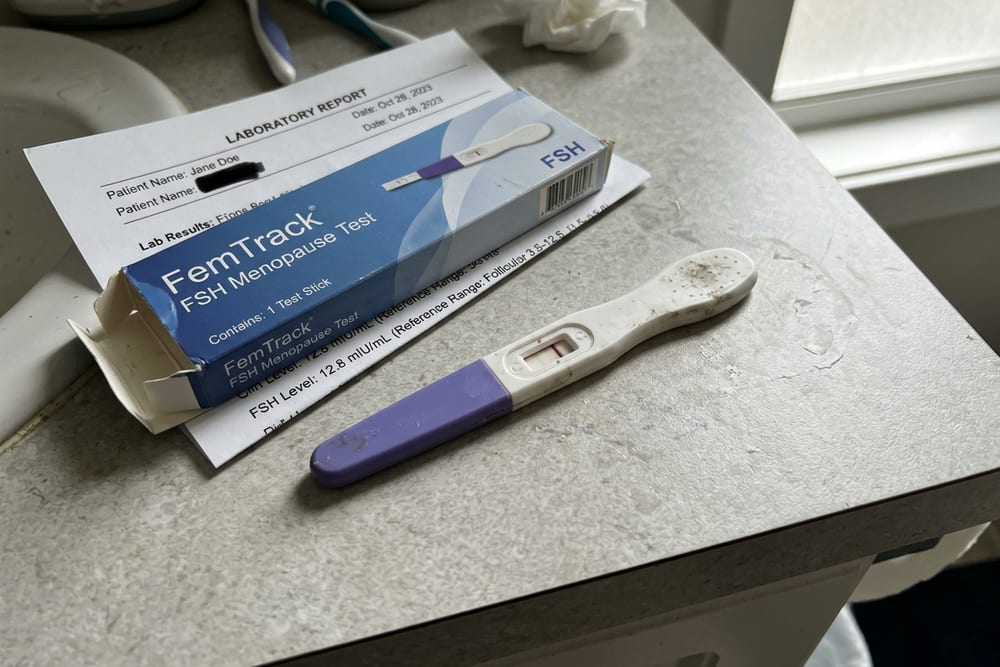
At-home FSH urine kits — Clearblue Menopause Stage Indicator, MeMD Menopause Test, and similar products — detect whether your urinary FSH is above approximately 25 mIU/mL. The threshold and the underlying technology are essentially the same as the immunoassay-based home pregnancy test, which has been validated for decades. The kits work as advertised: they correctly detect whether the FSH in that urine sample, on that day, is above the threshold. The problem is what you can conclude from that one moment.
A positive result (FSH high) on an at-home kit confirms that your FSH was elevated on the day you tested. If you have classic perimenopausal symptoms and a positive kit reading, the kit agrees with what your symptoms already told you. A negative result (FSH low) on a single kit reading is not informative — it could mean you are not in perimenopause, or it could mean you sampled on a low-FSH day in a woman whose FSH is fluctuating across the diagnostic threshold week to week. Hale et al. (2014) and the SWAN data make clear why a single negative reading does not rule out perimenopause.
The most defensible use of at-home kits is the multi-test format that asks you to test on multiple cycle days and look at the pattern across all of them. Even then, the diagnostic gain over a structured symptom interview is small, and the cost-per-information-unit is worse than a single Day-3 FSH+E2 blood panel.
Cost: $20-40 for a multi-test kit. Best for: confirming symptoms with a number, women who want to do something quantitative themselves. Limitation: false-negative-prone, doesn't change clinical management.
The cheap useful labs your doctor should still run
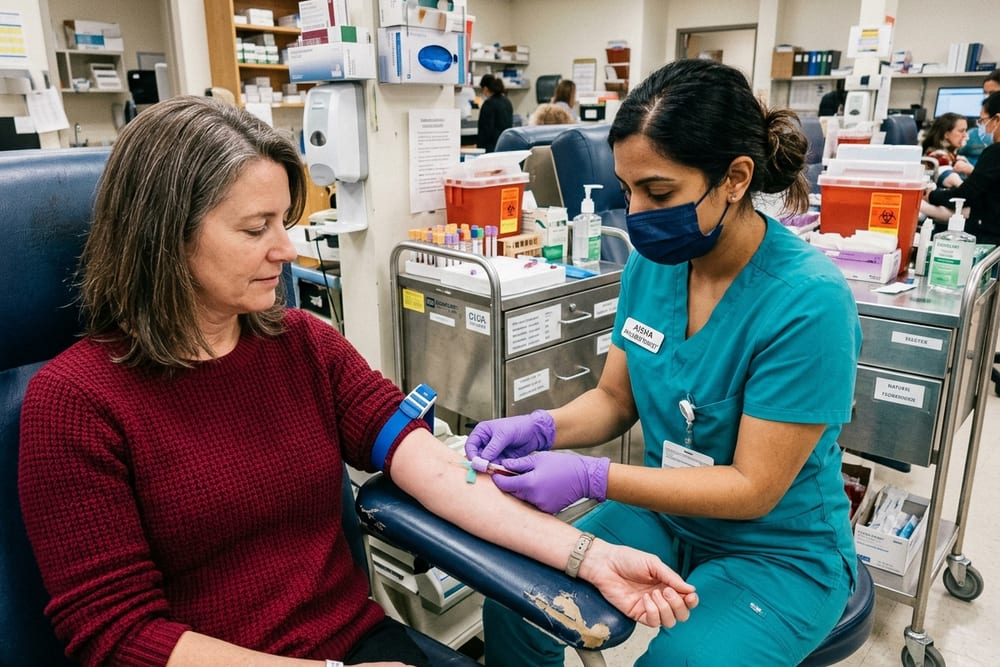
Even if no perimenopause test is required to diagnose perimenopause, there are five lab values worth checking — not to confirm perimenopause, but to rule out conditions that mimic perimenopausal symptoms or that often coexist with them. These are the cheap, high-yield panel that any thorough workup should include before assuming hormones explain everything.
- TSH (thyroid-stimulating hormone). Hypothyroidism causes fatigue, weight changes, mood changes, sweating, irregular periods, dry skin, and brain fog — almost the entire perimenopausal symptom set. Hyperthyroidism causes anxiety, heat intolerance, palpitations, sleep disruption, and irregular periods. Both are common in midlife women and both are easily missed if you assume perimenopause. A TSH (and free T4 if TSH is abnormal) is the cheapest move with the highest diagnostic yield.
- Ferritin and CBC. Heavy or prolonged perimenopausal bleeding causes iron deficiency. Iron deficiency causes fatigue, exercise intolerance, brain fog, hair shedding, and restless legs — symptoms easily attributed to "perimenopause" alone. A CBC catches anemia; ferritin catches iron deficiency before anemia develops, which is the more common scenario in perimenopausal women.
- 25-hydroxyvitamin D. Vitamin D deficiency is widespread and causes mood changes, sleep disturbance, musculoskeletal pain, and bone-health concerns that overlap with perimenopause. Repleting deficiency before adding HRT clarifies which symptoms are hormone-driven and which were deficiency-driven. Cheap, useful.
- Fasting lipid panel and HbA1c. Cardiovascular and metabolic risk shifts in perimenopause as estrogen drops; capturing baseline lipids and glucose homeostasis at the start of the transition is good preventive medicine, regardless of HRT decisions.
- Comprehensive metabolic panel. Catches kidney and liver issues that occasionally present with vague midlife symptoms. Cheap add-on.
The whole rule-out panel — TSH, CBC, ferritin, vitamin D, lipid panel, HbA1c, comprehensive metabolic panel — runs roughly $80-150 cash without insurance and is almost always covered when ordered by a clinician evaluating a midlife woman with the symptom cluster. Combined with a structured symptom interview and (if you want a number) a Day-3 FSH+E2, that workup catches most of the conditions that masquerade as perimenopause and confirms the hormonal driver when present.
What about saliva and "comprehensive hormone panel" tests?
The direct-to-consumer hormone-test market is large, well-marketed, and largely a waste of money for the typical perimenopausal woman. Two categories deserve a specific contrarian note.
Salivary hormone panels. These measure unbound (free) steroid hormones — estradiol, progesterone, testosterone, cortisol, sometimes DHEA — in saliva, which is positioned as more "physiologically relevant" than blood. The actual clinical performance is poor. Salivary levels show high intra-individual variability, are sensitive to collection timing and food intake, and don't correlate well with the bound-plus-free serum levels that clinicians actually use to make HRT and dosing decisions. NAMS, the Endocrine Society, and ACOG do not recommend salivary hormone testing for menopause diagnosis or HRT dosing. The tests cost $200-400 and the result is rarely actionable — most clinicians will rerun a serum panel before making any prescribing decisions.
"Comprehensive hormone panels" sold direct-to-consumer. These bundle eight to fifteen hormones — sometimes blood, sometimes saliva, sometimes a "Dutch test" dried-urine panel covering metabolites — for $150-400. The marketing pitch is "see your full hormonal picture." The clinical reality is that adding nine hormones nobody asked about (DHEA-S, pregnenolone, every estrogen metabolite) does not improve diagnostic accuracy for perimenopause. It generates extra numbers, some of which will be flagged as "abnormal" purely because of the lab's reference range, prompting follow-up tests and supplements that don't change outcomes.
The exception that proves the rule: if you have a specific clinical question that requires a specific hormone — for example, suspected adrenal insufficiency requiring a morning cortisol, or suspected PCOS requiring testosterone and SHBG — order that targeted test. The shotgun panel rarely earns its price tag. The cheapest accurate path for the typical woman wondering about perimenopause is the symptom interview plus a $40-80 Day-3 FSH+E2 plus the cheap rule-out panel above. Total cost under $200. Total useful information vastly higher than the $400 saliva-and-Dutch panel.
The ClearedRx symptom score as a starting point
If symptoms outrank every blood test for diagnosing perimenopause, the cheapest, fastest first move is a structured symptom inventory. Our free Menopause Symptom Score is a 60-second self-check that scores the perimenopausal symptom cluster as a single hormonal-fingerprint number. It captures the same axes a STRAW+10-trained clinician would assess in a structured interview: vasomotor symptoms (hot flashes, night sweats), sleep disruption, mood and cognitive changes, urogenital symptoms, and cycle pattern. The score is calibrated against the published symptom-cluster prevalences from the SWAN cohort and from Heitkemper / Mulak / Andersen.
Our companion perimenopause self-check is a 10-question screen specifically targeted to where you are in the transition (early perimenopause, late perimenopause, or postmenopausal). The two tools are complementary: the symptom score quantifies severity; the self-check stages where in the transition you are. Both produce a result that is useful input to a clinician conversation — and both cost nothing.
The reason these tools are the recommended starting point, not a hormone test: the answer they give you is the same answer the gold-standard clinical interview would give you, in 60 seconds, with no blood draw. If your score is high and your stage is mid-to-late perimenopause, the next conversation is whether HRT is appropriate for your specific picture — not whether to spend $40-400 on more labs.
How a perimenopause test fits into the HRT decision
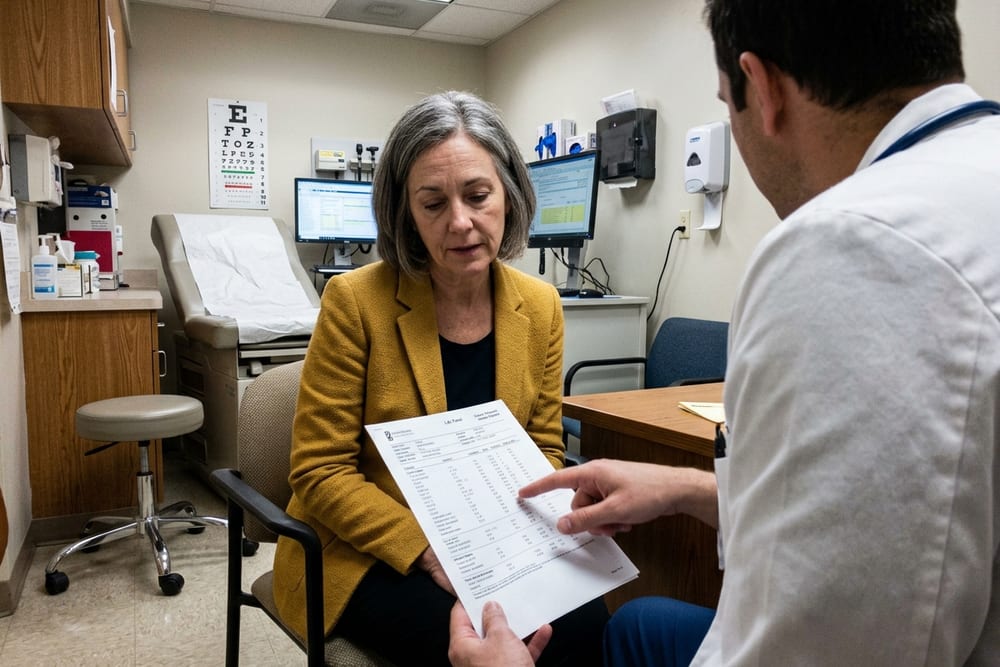
The reason most women search "perimenopause test" is not academic curiosity. It is a stand-in for a different question: am I a candidate for treatment? The honest answer is that the test does not gate the treatment decision in the way most people assume. NAMS 2022 is explicit that symptomatic perimenopausal women age 40+ can be prescribed HRT based on the clinical picture alone — no confirmatory FSH, no confirmatory estradiol, no AMH. The test is downstream of the decision, not upstream.
What does inform the HRT decision is the full clinical picture: age, symptom severity, cardiovascular risk profile, breast cancer risk profile, time since the last menstrual period, and any contraindications. A menopause-trained clinician walks through that picture with you in a single 15-minute conversation and arrives at one of three answers — yes HRT is appropriate and here is the formulation, no HRT is not appropriate because of these specific factors, or let's address these other contributors first (deficiency, sleep hygiene, thyroid) and revisit. Our signs you need HRT piece walks through the decision tree in detail. For broader context on where you are in the transition, our perimenopause vs menopause, how long does menopause last, and signs perimenopause is ending pieces map the timeline.

"The diagnosis of menopause is clinical, based on age and the cessation of menses. Hormone testing is generally not necessary or recommended to diagnose perimenopause or menopause. FSH and estradiol levels fluctuate widely during the menopausal transition and a single measurement may not accurately reflect ovarian function." — The North American Menopause Society. The 2022 Hormone Therapy Position Statement of The North American Menopause Society. Menopause. 2022;29(7):767-794. PMID: 35797481.
The perimenopause test comparison table
Side by side, here is how each rung of the diagnostic ladder stacks up. The "best for" column is the question each test actually answers — which is rarely the question users assume it answers.
| Test | Measures | Cost | Best for | Limitation |
|---|---|---|---|---|
| Symptom-based clinical diagnosis (STRAW+10) | Cycle pattern + symptom cluster | $0-50 (telehealth visit) | Diagnosing perimenopause; gold standard per NAMS 2022 | Requires a clinician familiar with STRAW+10 |
| Day-3 FSH + estradiol (blood) | Baseline FSH and estradiol on cycle day 3 | $40-80 cash | Wanting a number; under-40 POI workup; atypical cases | False-negative-prone; useless on hormonal contraception |
| AMH (blood) | Ovarian reserve via small follicle output | $80-150 cash | Time-to-FMP, fertility planning, on-pill workup | Doesn't diagnose current perimenopause; doesn't change HRT decisions |
| At-home FSH urine kits | Urinary FSH above ~25 mIU/mL threshold | $20-40 (multi-test kit) | Confirming a high-FSH day; quantifying what symptoms already say | Single negative result not informative; doesn't change management |
| Cheap rule-out labs (TSH, ferritin, vit D, CBC, lipids) | Conditions that mimic perimenopause | $80-150 cash, often insurance-covered | Ruling out thyroid disease, anemia, deficiency before assuming hormones | Doesn't diagnose perimenopause itself; rules out look-alikes |
| Salivary hormone panels | Free hormone in saliva | $200-400 | — | Not recommended by NAMS, Endocrine Society, ACOG; high variability; rarely actionable |
| "Comprehensive" DTC panels (Dutch + multi-hormone) | 8-15 hormones & metabolites | $150-400 | — | Adds noise without diagnostic gain; mostly marketing |
If you want to map the rest of the picture
A perimenopause test rarely travels alone — what it sits inside is a fuller picture of where you are in the transition and what to do about it. Mapping that picture is the cheapest diagnostic move you can make. Our free Menopause Symptom Score is the 60-second self-check that scores the cluster as a single hormonal-fingerprint number, and our perimenopause self-check stages where in the transition you are. For the broader symptom catalogue, see our menopause symptoms overview; for prevalence data across symptoms, our menopause statistics 2026 page has the numbers. For sister-article context, our perimenopause vs menopause piece walks through which symptom-stage maps to which treatment, our signs you need HRT piece walks through when the conversation is worth having, our how long does menopause last piece sets the timeline, and our signs perimenopause is ending piece tells you when you're nearing the other side.
Frequently asked questions
Do I need a perimenopause test to start HRT?
No. The 2022 NAMS Hormone Therapy Position Statement (PMID 35797481) is explicit: perimenopause is diagnosed clinically by age and symptoms, not by hormone testing. A clinician can prescribe HRT for symptomatic perimenopausal women age 40+ without any FSH or estradiol test. Tests can rule out other causes (thyroid disease, anemia, deficiency) but are not required to diagnose perimenopause itself or initiate HRT. See our signs you need HRT piece for the decision tree.
Is at-home FSH testing reliable?
Not for diagnosing perimenopause. At-home FSH urine kits (Clearblue, MeMD, etc.) detect whether your urinary FSH is above approximately 25 mIU/mL — the same threshold the kits used 30 years ago. The problem is biological, not technological: FSH levels fluctuate wildly cycle to cycle in perimenopause (Sowers 2008 SWAN, PMID 18445660). A single elevated reading confirms a high-FSH day. A normal reading does not rule out perimenopause — Hale et al. (2014, PMID 24134950) showed FSH can swing from premenopausal to postmenopausal range within the same cycle. Use them for curiosity, not diagnosis.
What's the most accurate perimenopause test?
Symptom-based clinical diagnosis with age remains the gold standard. The Stages of Reproductive Aging Workshop +10 (STRAW+10) criteria (Harlow 2012, PMID 22343510) — used by NAMS, Endocrine Society, and IMS — stages perimenopause primarily on menstrual cycle changes and bleeding patterns, with hormone levels as supplementary. If you want a blood test, cycle Day-3 FSH plus estradiol is the most clinically useful single panel, but even that is imperfect because of the same fluctuation issue. No single test is more accurate than a structured symptom interview by a clinician familiar with STRAW+10.
Why does my FSH come back normal when I have all the symptoms?
Because FSH in perimenopause is not a steady-state hormone — it spikes and crashes cycle to cycle and even within a single cycle. Sowers et al. (2008) in the SWAN cohort (PMID 18445660) measured FSH longitudinally across the menopausal transition and documented intra-individual swings that would put the same woman in "normal premenopausal," "perimenopausal," and "postmenopausal" ranges in different draws. A normal FSH reading doesn't mean you're not in perimenopause; it means your FSH on that day was below the threshold. Symptoms outrank hormone levels for diagnosis.
Can I test for perimenopause if I'm on birth control?
Hormonal contraception suppresses FSH, LH, and estradiol artificially, so an FSH or estradiol test on the pill, the patch, the ring, or hormonal IUDs (low-dose) will not give you a meaningful perimenopause reading. AMH is less affected by hormonal contraception and may still be useful for assessing ovarian reserve, but it is not a perimenopause-status test. The practical workflow if you want a meaningful test: stop hormonal contraception for 6-8 weeks, get a Day-3 FSH and estradiol if you have a cycle to time. Or, more practically, skip the test, document the symptoms, and discuss whether HRT (which doesn't require a test) is appropriate.
What's the difference between FSH and AMH testing?
FSH (follicle-stimulating hormone) rises as the ovary becomes less responsive — it's a downstream signal that the brain is shouting at the ovaries. FSH fluctuates wildly cycle to cycle in perimenopause and is most useful as a Day-3 sample alongside estradiol. AMH (anti-Müllerian hormone) is produced by small developing follicles in the ovary itself; it reflects ovarian reserve more directly and falls steadily with age, with much less cycle-to-cycle noise (Sluss 2008). AMH is most useful for predicting time-to-final-menstrual-period (FMP) — Tepper et al. (2015) showed AMH can predict the FMP within a 1-3 year window. AMH does not diagnose perimenopause. They answer different questions: FSH = "is my ovary tired today?", AMH = "how many years of ovarian function are likely left?"
How much do perimenopause tests cost?
Symptom-based diagnosis with a menopause-trained clinician: free to $50 (a telehealth visit). Day-3 FSH plus estradiol blood test: typically $40-80 cash without insurance, often covered if your clinician orders it for symptom workup. AMH blood test: $80-150 cash. At-home FSH urine kits (Clearblue Menopause Stage Indicator and similar): $20-40 for a multi-test kit. Comprehensive direct-to-consumer "hormone panels" marketed for menopause: $150-400 — most of what you're paying for is marketing. The cheapest accurate path is the free symptom interview plus a $40-80 Day-3 FSH+E2 if a number would change your decision.
Should I get a saliva hormone test?
No, not for perimenopause diagnosis. Salivary hormone panels marketed by direct-to-consumer labs measure unbound (free) steroid hormones in saliva, which sounds plausible but produces highly variable results that don't correlate well with the bound-plus-free serum levels clinicians actually use to make decisions. NAMS, Endocrine Society, and ACOG do not recommend salivary hormone testing for menopause diagnosis or HRT dosing. The "comprehensive panel" price (often $200-400) is significantly more than a Day-3 FSH+E2 blood draw with much less interpretive value. Save the money.
What other labs should my doctor run?
The cheap useful labs that rule out conditions that mimic perimenopause: TSH (thyroid disease causes fatigue, weight changes, mood changes, sweating, irregular periods that overlap heavily with perimenopause); ferritin (iron deficiency from heavy perimenopausal bleeding causes fatigue and brain fog); 25-hydroxyvitamin D (deficiency causes mood changes, sleep disturbance, bone health concerns relevant to perimenopause); fasting lipid panel and HbA1c (cardiovascular and metabolic risk shifts in perimenopause); CBC (rule out anemia from heavy bleeding). Adding these to a Day-3 FSH+E2 catches the most common look-alikes for under $100 in cash labs.
Do I need a perimenopause test or can I just use my symptoms?
For most women age 40+ with classic perimenopausal symptoms (hot flashes, night sweats, irregular cycles, sleep disruption, mood changes, cognitive changes), symptoms alone are sufficient — that is the NAMS 2022 position. Tests are useful in three specific situations: (1) you're under 40 and need to rule out premature ovarian insufficiency, where elevated FSH + low estradiol on two separate occasions is part of the diagnosis; (2) your symptoms are atypical or severe and you need to rule out thyroid disease, anemia, or other mimics; (3) you want a baseline number for your own tracking. For everyone else, the symptom interview plus a $0-80 cheap-labs panel is enough — and then the conversation moves to whether HRT is the right next step.
Sources & references
- The North American Menopause Society. The 2022 Hormone Therapy Position Statement of The North American Menopause Society. Menopause. 2022;29(7):767-794. PMID: 35797481
- Harlow SD, Gass M, Hall JE, et al. Executive summary of the Stages of Reproductive Aging Workshop +10: addressing the unfinished agenda of staging reproductive aging. J Clin Endocrinol Metab. 2012;97(4):1159-1168. PMID: 22343510
- Sowers MR, Zheng H, Greendale GA, et al. Hormone predictors of bone mineral density changes during the menopausal transition. J Clin Endocrinol Metab. 2008;93(4):1190-1196. PMID: 18445660
- Hale GE, Robertson DM, Burger HG. The perimenopausal woman: endocrinology and management. J Steroid Biochem Mol Biol. 2014;142:121-131. PMID: 24134950
- Tepper PG, Randolph JF Jr, McConnell DS, et al. Trajectory clustering of estradiol and follicle-stimulating hormone during the menopausal transition among women in the SWAN. J Clin Endocrinol Metab. 2012;97(8):2872-2880. PMID: 22659249
- Sluss PM, Hayes FJ, Adams JM, et al. Mass spectrometric and physiological validation of a sensitive, automated, direct immunoassay for serum estradiol using the Architect. Clin Chim Acta. 2008;388(1-2):99-105. PMID: 17988657
- Endocrine Society. Menopause and Hormone Therapy Clinical Practice Guideline (2024 update). endocrine.org
- American College of Obstetricians and Gynecologists. Hormone Therapy in Postmenopausal Persons (Practice Bulletin). acog.org
- Internal: menopause symptoms overview · menopause statistics 2026 · menopause symptom score tool · perimenopause self-check · perimenopause vs menopause · signs you need HRT · how long does menopause last · signs perimenopause is ending
Skip the test debate — talk to a menopause-trained clinician about HRT
ClearedRx prescribes evidence-based HRT — bioidentical estradiol, progesterone, or a combined cream — based on your full picture, with 24-hour MD review and free shipping in all 50 states. Compounded preparations from $49/month, FDA-approved generics from $89/month. No insurance hassle. New patients save 50% on the first month.
Find out if HRT is right for me